- DataMigration.AI
- Posts
- The Migration Bill Nobody Warned Your Board About
The Migration Bill Nobody Warned Your Board About
It starts with portfolio discovery.


Shen Pandi & Damian - Data Migration Expert
April 02, 2026
What’s in it?
94% of enterprises use cloud services, yet most migrations stall, overspend, or break something critical
73% of migrations exceed budget when compliance is treated as a last-minute checkbox
Every manual step in your migration is a failure point waiting to surface at the worst time
Multi-cloud without unified governance means your CFO cannot attribute a single dollar of spend
The fastest cloud transformations are won by visibility, not by the biggest budget
94% of enterprises now run cloud services. Yet most cloud migration programs stall, overspend, or break something critical before they deliver real value. If you are a CEO, CFO, or founder who signed off on a cloud transformation roadmap, there is a real chance the execution beneath that plan is quietly drifting off course right now.
The cloud does not fail because the technology is wrong. It fails because the strategy was built for a world that no longer exists.
Your CTO presented a migration plan six months ago. Workloads were listed. A provider was selected. Timelines were locked. Then your compliance team flagged a data residency issue nobody had mapped. A billing system took longer to sync than expected. Costs began climbing faster than performance gains justified. By the time a report reached your desk, the problem was already months old.
This is not a technology failure. It is a governance and strategy failure. And the earlier you identify where those gaps live, the less it will cost you to close them.
Is Your Current Migration Wave Already Off Course? Get a Free Strategy Audit Before the Next Bill Arrives
Paper Plans Don't Survive Production
Most migration plans survive the boardroom and collapse in production. Workloads are listed. Timelines look reasonable. Budgets appear defensible.
What those plans rarely account for is operational reality. Legacy systems carry undocumented dependencies that only surface mid-migration. Regulated data flows cross jurisdictions that were never mapped. AI and analytics workloads demand infrastructure that the original plan never anticipated.

By 2026, the cloud infrastructure market is projected to reach $1.56 trillion. Your competitors are not debating whether to migrate. They are deciding which workloads to run at the edge, which to keep in private environments, and which to scale across public cloud providers.
While your team is resolving issues from the first migration wave, organizations ahead of you are already managing distributed cloud environments as a single operating fabric. The difference between a migration that moves workloads and one that builds competitive advantage is strategy. Specifically, it is the right workload classification, governance architecture, and cost controls applied before anything moves.
The 5 Costly Mistakes That Are Silently Destroying Your Cloud ROI
Mistake 1: You Are Moving Workloads Without Classifying Them First
Picking a provider and starting migration is the wrong sequence. The right sequence starts with understanding every workload: its latency requirements, its compliance boundaries, its data residency rules, and its cost-to-performance profile.
A fraud detection service may need edge deployment for sub-50ms responses. A billing platform may need to stay in a private cloud for regulatory reasons. Without this classification step, your organization is making architecture decisions by guessing. Guessing at scale is expensive. Rearchitecting after go-live is more expensive.
Mistake 2: You Are Treating Compliance as a Late-Stage Checkbox
Over 60% of organizations list improved data security and regulatory compliance as primary reasons to migrate to the cloud. Yet most migration plans handle compliance as a checkpoint near go-live rather than a foundational design principle built into every placement decision.
If your organization operates under HIPAA, PCI-DSS, SOC2, or any data residency regulation, compliance logic needs to live inside your workload placement model from day one. Region-locked storage, encryption by default, continuous compliance scanning, and immutable audit trails are not features you add later. When missed, they create audit exposure and sometimes force full re-migration of workloads that were already live.
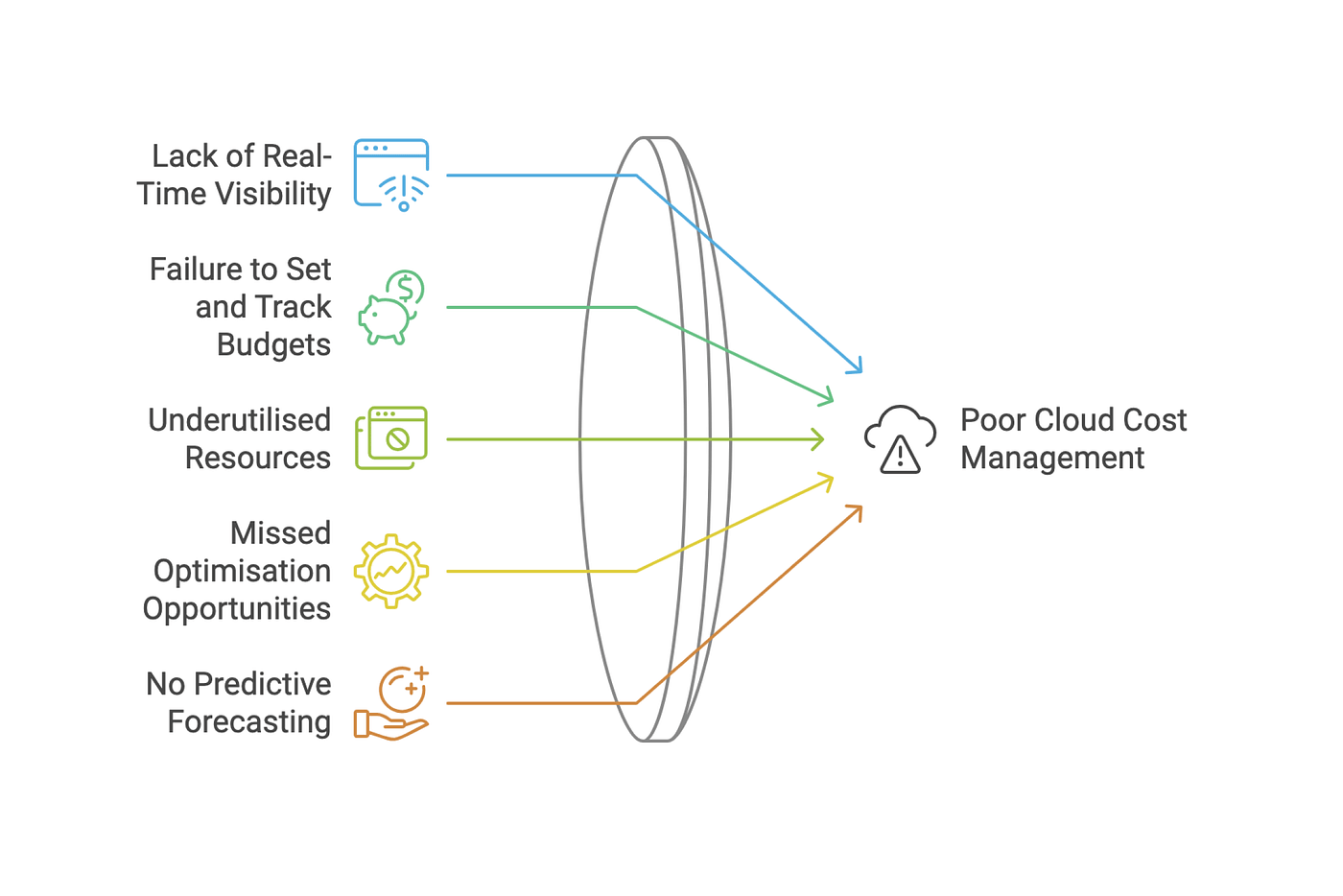
Mistake 3: Your Cost Model Has No Real Controls Built In
Cloud environments grow faster than any budget projection assumes. New services spin up. Test environments stay running. Data egress charges accumulate in ways nobody flagged during planning.
Without FinOps baselining before migration and unit cost tracking per workload after migration, cloud spend becomes a runaway line item on your P and L. The enterprises getting cloud ROI right track cost-per-workload, set automated budget thresholds, and build chargeback structures that hold individual teams accountable for consumption. If your current plan skips this, the cost overruns are not a risk. They are a certainty.
Mistake 4: You Have No Unified Governance Across Environments
Most enterprises discover the governance problem after it has already created damage. Security policies start consistently, then diverge as new environments appear. Access rules fall out of alignment. Encryption configurations drift. Different teams adopt different monitoring tools, and suddenly there is no single view of what is running, where, or under what controls.
Policy-as-code frameworks, centralized identity management, and unified cloud management platforms close this gap. They are the difference between an environment you can audit in hours and one that takes weeks to reconcile before a regulator visit.
Mistake 5: You Are Running Migrations Without Automation at the Core
Manual configuration does not scale. Manual testing does not scale. Manual compliance checks do not scale.
Enterprises executing cloud migration reliably in 2026 use infrastructure-as-code, standardized migration pipelines, automated rollback procedures, and zero-touch environment provisioning. Every manual step in your current process is a failure point, a delay risk, and a governance gap waiting to surface at the worst possible time.
What a Workload-First Migration Actually Produces
The shift from platform-first to workload-first migration is not a philosophy. It is a practical change in sequencing that produces measurably better outcomes at every stage of execution.
It starts with portfolio discovery. Every application is inventoried, every dependency is mapped, and every workload is classified by latency, compliance, criticality, and cost profile. This phase alone surfaces legacy integrations that have been running critical processes for years but were never formally documented anywhere.
From there, architecture and governance are defined before any environment is built. Security boundaries, identity frameworks, logging standards, and policy enforcement are established at the foundation level. This is what prevents the governance drift that quietly undermines migrations that started with strong intentions.

Landing zones come next. These are pre-configured, policy-enforced environments that workloads migrate into, removing the need to rebuild controls manually for every migration wave.
Migration then runs as a structured factory model with standardized pipelines, automated validation, controlled cutover windows, and real-time progress reporting. Large portfolios move at pace without sacrificing reliability or governance quality.
After migration, modernization continues. Costs are rightsized. Performance is optimized. AI-driven workload scheduling adjusts placement dynamically as demand patterns shift across environments.
The Hidden Cost of Getting Multi-Cloud Wrong
If your organization distributes workloads across more than one cloud provider, multi-cloud complexity compounds every problem described above.
Distributed environments without a unified control plane mean your teams are managing inconsistent policies, fragmented monitoring, and separate identity systems across every provider at the same time.
The practical result is slower incident response, inconsistent compliance posture, and cloud spend that is nearly impossible to attribute accurately to a business unit, product, or team.
Your board is asking about cloud ROI. Your CFO wants to spend visibility. Your security team is trying to maintain a consistent control surface. Without a unified orchestration and governance layer, none of these needs can be met simultaneously.
Enterprises solving this problem are using centralized cloud management platforms that aggregate provisioning, policy enforcement, cost monitoring, and observability across every environment.
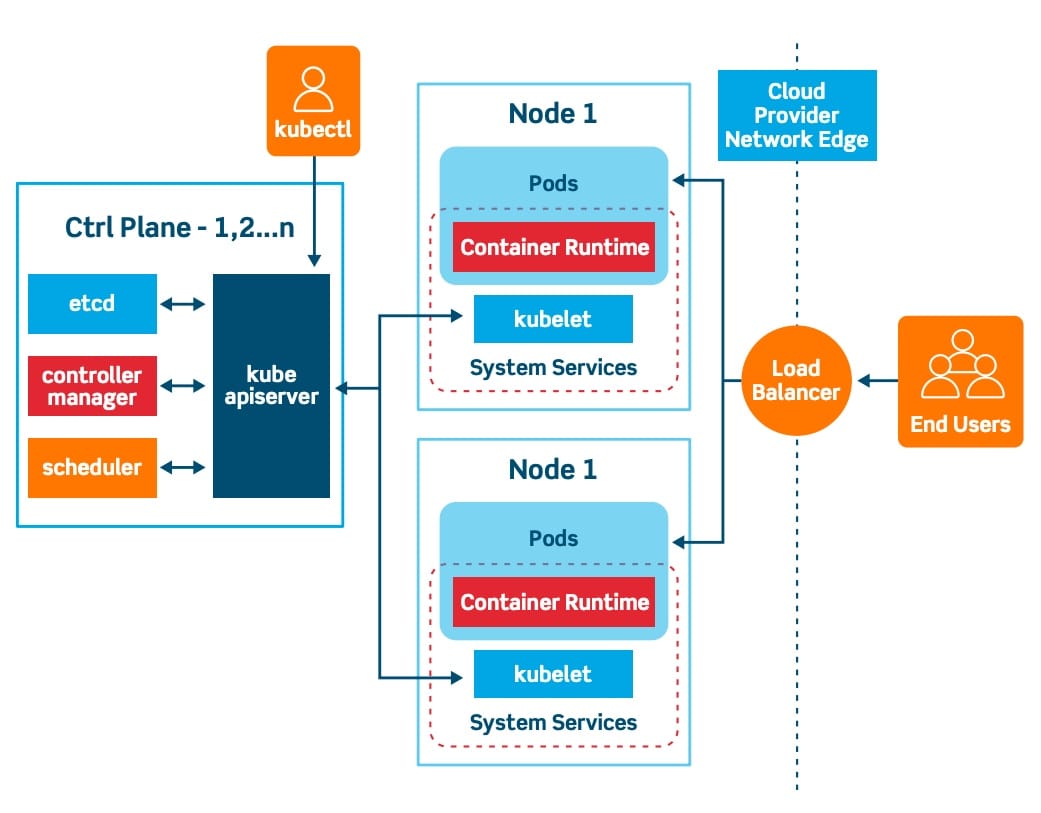
They run Kubernetes as a common runtime layer, so workloads shift between environments without requiring redeployment logic changes. They apply service mesh frameworks to create consistent networking across hybrid and multi-cloud setups.
This is not a future-state architecture. This is what operational multi-cloud looks like right now for the organizations outperforming their industries.
The Layer Your Current Migration Stack Was Never Built to Handle
Most migration tools move workloads. This platform governs the data behind them, before, during, and after every migration wave.
Before you migrate, the platform surfaces compliance boundaries and data sensitivity profiles so workload placement decisions are made correctly the first time, not corrected after go-live.
During migration, continuous compliance monitoring catches policy violations in real time and triggers automated remediation. Your governance posture holds even as environments scale fast.
After migration, your CFO gets workload-level cost attribution. Your security team gets a clean audit trail, no black boxes. No emergency evidence runs before a regulator review.
For you as a CEO or founder, cloud transformation stops being something you sign off on and wait to hear about. It becomes a program you can track and hold accountable.
Public cloud, private infrastructure, hybrid setups. One governance layer across all of it.
The metrics your board actually wants to see
Successful cloud migration is not measured by the number of workloads moved. It is measured by business outcomes your leadership team can actually see and defend.
The metrics that matter are: uptime improvement against your SLA commitments, response latency before and after migration, cost per workload compared to legacy run costs, deployment frequency, mean time to recovery, and compliance audit cycle time.
If your current migration program cannot produce these numbers with confidence, you are running a transformation without accountability. That is a risk position no CEO, CFO, or board should accept going into the next planning cycle.
Stop Approving Migration Plans You Cannot Track. Start Governing the Ones You Have.
Cloud transformation is not a one-time project with a completion date. It is an ongoing operating model that requires continuous governance, continuous optimization, and continuous visibility across every environment your organization touches.
Your competitors who are getting this right did not find a better cloud provider. They built better controls around the data moving through their environments. They classified workloads before moving them. They embedded compliance before it became a crisis. They built cost accountability into the fabric of every environment they operate.
You can do the same. The question is whether you start before the next migration wave creates problems, or after.
Book a Demo and See How DataManagement.AI Turns Cloud Migration Risk Into a Governed, Measurable Program Your Leadership Team Can Actually Track

The enterprises moving fastest on cloud transformation are not the ones with the largest budgets. They are the ones with the clearest visibility into what their data is doing, where it lives, and what it costs. That clarity is precisely what DataManagement.AI is built to give you.
Thank you for reading
DataMigration.AI & Team