- DataMigration.AI
- Posts
- The Ultimate Checklist for Data Migration Validation and Verification
The Ultimate Checklist for Data Migration Validation and Verification
Getting Data Migration Validation Right.

Damian - Data Migration Expert
October 30, 2025
What’s in it?
Data migration success depends entirely on a robust validation process.
Poor validation leads to project failure, compliance risks, and massive costs.
Validation must be continuous across three phases: before, during, and after migration.
Use specific techniques like record counts and checksums to verify data integrity.
Automate validation to overcome scale and complexity challenges.
Treat validation as a strategic business imperative, not just a technical task.
Data migration has become a strategic imperative for your organization, whether you're modernizing legacy systems, moving to the cloud, or consolidating platforms. But your success depends entirely on one critical factor: implementing a robust and reliable validation process.
Consider these sobering statistics that should inform your approach:
83% of data migration projects either fail or exceed their budgets and timelines, primarily due to poor planning and inadequate validation (Oracle).
95% of businesses suspect their data might be inaccurate, yet only 44% have consistent data quality checks across systems (Experian).
Poor data quality costs companies an average of $12.9 million annually in lost productivity and missed opportunities (Gartner).
In regulated sectors like banking, healthcare, and telecom, a single data mismatch during your migration can trigger compliance failures, customer churn, and significant legal liabilities.
Why Data Migration Validation Is Your Business Imperative
Data migration validation ensures your data transfers accurately, completely, and securely from source to destination systems. Think of it like moving houses: it's not enough to load boxes onto the truck; you need to verify everything arrives intact, organized, and ready to use at your new home.
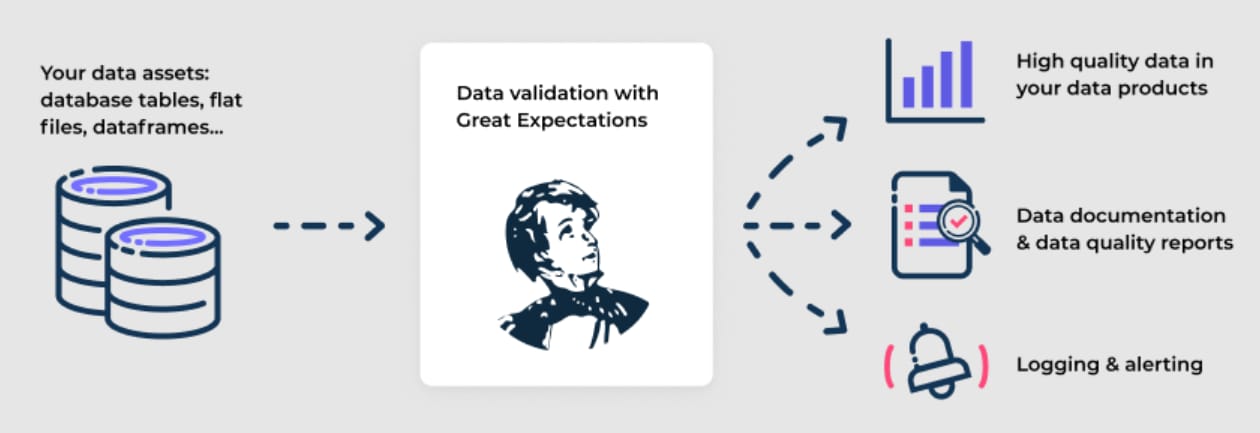
When you skip proper validation, you risk:
Losing or corrupting critical data, leading to faulty analytics and incorrect business decisions
Compromising regulatory compliance under laws like GDPR or HIPAA
Disrupting operations as systems relying on clean data may fail unexpectedly
Damaging customer trust and brand reputation when data issues affect user experience
The Three Phases of Your Data Migration Validation
To ensure your data arrives accurately and ready for use, you must treat validation not as a single event, but as a continuous process embedded throughout your migration journey.
This means actively checking the integrity of your data in three distinct but interconnected stages: before it is moved, while it's in transit, and after it has arrived in its new location.
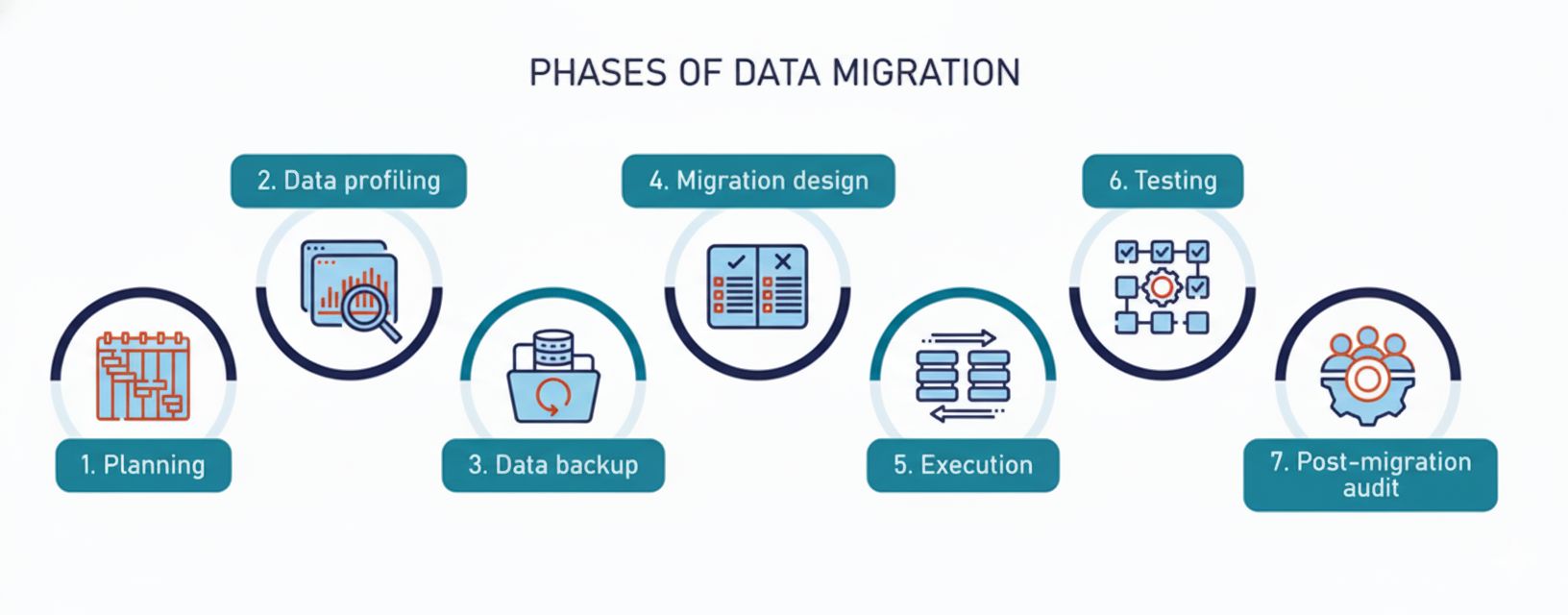
By understanding and executing these three phases, you shift from a reactive posture of finding problems to a proactive strategy of preventing them.
1. Pre-Migration Validation: Plan and Profile
Before moving any data, you must:
Profile your source data to identify anomalies, missing values, and duplicates
Validate schema compatibility between source and target systems
Define and test your data mapping rules and transformation logic
Best Practice: Use automated profiling tools to detect data quality issues before migration begins.
2. In-Migration Validation: Test and Track
While data moves, continuously verify:
Record-level accuracy and correct transformations
Row counts and checksum validation using hash totals
ETL pipeline accuracy and performance
Best Practice: Implement parallel run testing by operating old and new systems simultaneously to compare outputs.
3. Post-Migration Validation: Audit and Confirm
I was of opinion that db migrations as part of deployment process are mostly fine. Just had my ass saved because the process of applying migration was manual
— Anikait (@anikait1)
7:04 AM • Oct 29, 2025
After migration completion:
Generate reconciliation reports matching source and target records
Conduct functional testing to ensure business applications work correctly
Perform user acceptance testing with business stakeholders
Best Practice: Use automation frameworks to accelerate post-migration validation through regression testing.
Essential Validation Techniques for Your Toolkit
To execute these three validation phases effectively, you need a reliable set of tools and methods at your disposal.
Think of these techniques as your essential validation toolkit, each serving a distinct purpose, from verifying the sheer volume of data to ensuring its deepest structural and business integrity.
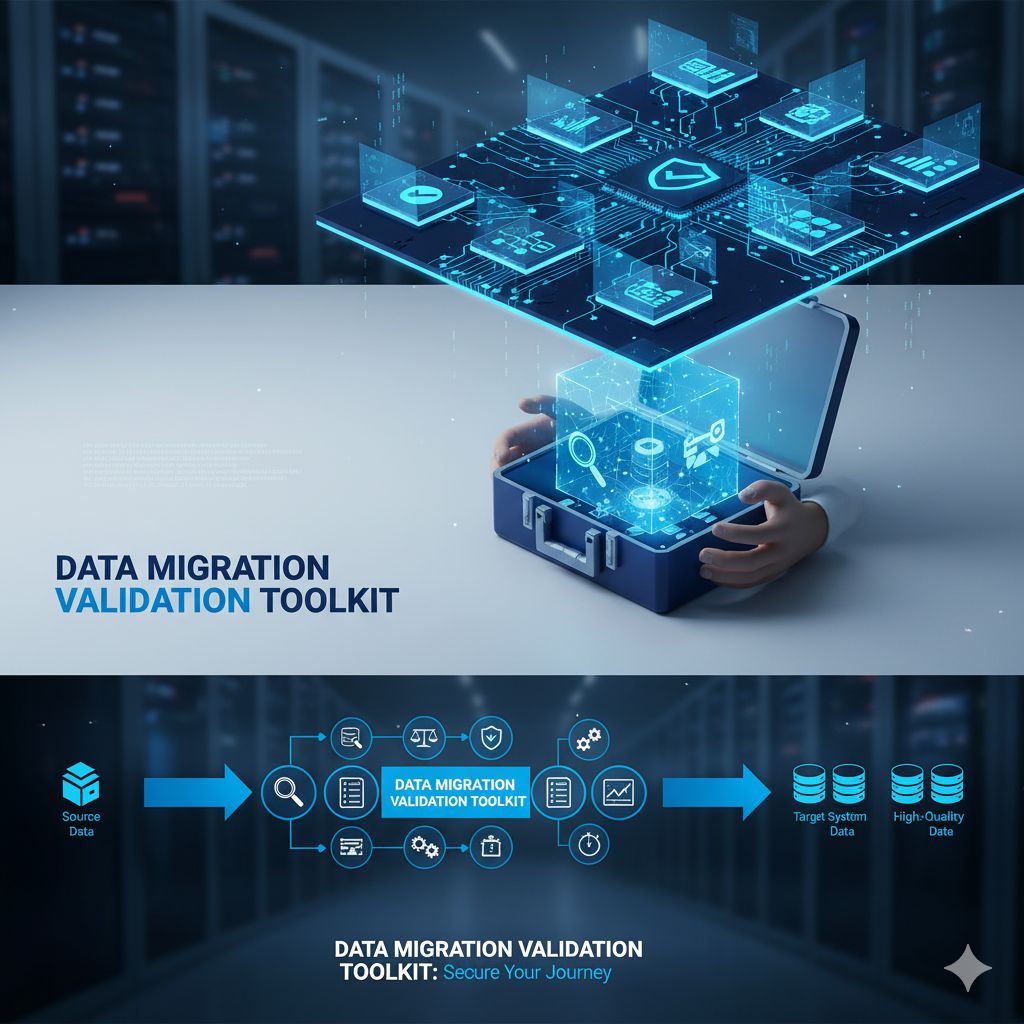
However, managing these validation techniques manually across complex migrations creates its own risks. This is where DataManagement.AI transforms your toolkit into an intelligent, automated system.
Our platform orchestrates the entire validation lifecycle, automating record matching, checksum verification, and integrity checks while maintaining full audit trails.
We ensure your validation isn't just technically sound, but business-relevant, giving you confidence that your migrated data will drive value from day one.

By mastering and deploying these techniques, you move beyond guesswork and gain the concrete evidence needed to certify that your migration is both complete and correct.
Record Count Matching: Verify identical record counts between source and target
Data Sampling: Randomly validate records using statistical approaches
Checksums/Hashing: Compare data file checksums pre- and post-migration
Schema Validation: Ensure fields, data types, and constraints remain intact
Referential Integrity Checks: Preserve relationship mappings and foreign keys
Automated Regression Testing: Validate that business processes still function correctly
Common Challenges You'll Face
Even with a solid plan and the right techniques, your validation process will inevitably encounter real-world obstacles.
How to ensure 𝗗𝗮𝘁𝗮 𝗤𝘂𝗮𝗹𝗶𝘁𝘆 𝗶𝗻 𝗠𝗮𝗰𝗵𝗶𝗻𝗲 𝗟𝗲𝗮𝗿𝗻𝗶𝗻𝗴 𝗦𝘆𝘀𝘁𝗲𝗺𝘀?
It is extremely important to ensure Data Quality upstream of ML Training and Inference Pipelines, trying to do it in the pipelines will cause unavoidable failure when working at scale.
— Aurimas Griciūnas (@Aurimas_Gr)
9:09 AM • Jul 23, 2023
Being aware of these common hurdles from the outset allows you to anticipate and mitigate them, rather than being caught off guard.
From the sheer scale of your data to inherited quality issues, understanding these challenges is the first step to developing a robust strategy to overcome them.
Expect these validation hurdles in your projects:
The volume and complexity of data make full validation resource-intensive
Data quality issues inherited from legacy source systems
Lack of automated validation tools is forcing error-prone manual processes
Inconsistent data formats between source and target systems
Schema mismatches are causing unexpected transformation failures
Insufficient testing resources and expertise
Tight migration timelines limit thorough validation
Best Practices for Your Successful Validation Strategy
Knowing the challenges is only half the battle; the other half is implementing a strategic framework to overcome them. These proven best practices transform validation from a reactive checklist into a proactive, strategic advantage.
By embedding these principles into your migration lifecycle, you can systematically address risks, enhance efficiency, and build a culture of confidence around your data's integrity.
Start Validation Early and Integrate Across Lifecycle

Don't wait until migration completion to begin validation. Start during planning to uncover critical gaps like missing identifiers or non-standard formats. A global bank identified that 20% of customer records lacked valid identifiers during planning; fixing this issue upfront prevented regulatory issues later.
Automate to Boost Speed and Accuracy
Manual validation becomes unsustainable at scale. Automated tools provide consistency, speed, and repeatability while strengthening audit readiness and reducing human error dependency.
Validate Business Logic, Not Just Fields
Beyond structural accuracy, ensure business rules and operational logic remain functional after migration. Verify calculations, relationships, and decision logic encoded within your data work as expected in the target environment.
Make It a Cross-Functional Effort

Collaborate across technical teams and business stakeholders. While IT manages structural accuracy, business users validate data usability and relevance. Include data governance, compliance, and subject matter experts to ensure comprehensive validation aligned with both technical standards and regulatory requirements.
Establish Measurable Validation KPIs
Define clear metrics like error rates, reconciliation percentages, audit findings, and time-to-resolution. Regular monitoring provides early issue detection and transparency for leadership, building organizational confidence in your migration outcomes.
Document Everything for Traceability

Maintain comprehensive records of test plans, validation results, data mappings, error logs, and approvals. Proper documentation supports audits, facilitates troubleshooting, and ensures accountability throughout your migration process.
Prepare Rollback and Recovery Options
No matter how thorough your validation, always have contingency plans. Design rollback procedures, backup strategies, and clear ownership to ensure minimal disruption and data loss if validation fails or unforeseen issues emerge post-migration.
The Bottom Line for Your Organization
Data migration validation isn't just a technical checkpoint; it's your strategic safeguard for business continuity, compliance, and stakeholder trust.
By embedding validation throughout your migration lifecycle, leveraging automation, and maintaining cross-functional collaboration, you transform data migration from a risky necessity into a confident, value-driven initiative.
Remember: Your data represents one of your most valuable organizational assets. Protecting its integrity during migration through rigorous validation isn't optional; it's essential for your current operations and future growth.
The organizations that master data migration validation don't just prevent failures; they build foundations for data-driven excellence that deliver competitive advantage long after the migration completes.
This is the exact assurance that DataManagement.AI delivers. Our platform embeds intelligent validation directly into your migration workflow, automatically verifying data integrity, preserving business context, and ensuring compliance at every step.

We transform migration from a high-risk project into a strategic opportunity to strengthen your data foundation, so you don't just move data, you elevate its value and reliability for the long term.
But a strong data foundation is only the beginning. The next frontier of competitive advantage lies in making that data actionable through intelligent, agentic systems.
This is the future we explore at Towards MCP, where we chart the course for AI agents that can securely access, reason with, and act upon your trusted data across any application.
It’s the logical next step in transforming your data asset into an autonomous intelligence.
Thank you for reading
DataMigration.AI & Team