- DataMigration.AI
- Posts
- What Your Competitors Know About Legacy Migration That You Don't
What Your Competitors Know About Legacy Migration That You Don't
Every Company Runs Cloud. Almost None Run It Right.


Shen Pandi & Damian - Data Migration Expert
March 19, 2026
What’s in it?
Your legacy system is not stable. It is silently draining up to 60% of your IT budget.
87% of IT leaders know modernization is critical. Most are still doing nothing about it.
94% of companies run in the cloud. The ones doing it wrong are handing rivals a 3-year head start.
Data governance built in from day one cuts migration defects by 63%. Yours isn't built in.
Your next migration phase will fail without this one move your competitors have already made.
The data migration truth your IT leadership has been avoiding for years.
THE REAL COST OF WAITING
Here is what your executive team probably will not say at your next board meeting. Your current infrastructure is not just aging. It is actively hemorrhaging money, blocking innovation, and giving your competitors an advantage that compounds with every quarter you delay a decision.
Your teams are managing data trapped across siloed systems. Regulatory requirements are stacking up faster than your compliance resources can process them. Meanwhile, artificial intelligence is reshaping every industry around you, and the organizations that get to AI-ready data infrastructure first are the ones writing the rules for the next decade. You are not facing a technical problem. You are facing a strategic one.
The enterprise modernization landscape has fundamentally shifted in 2026. It is no longer about finding the cheapest path to the cloud. It is about building the agile, intelligent data foundation that transforms your organization from reactive to genuinely predictive. The difference between those two states is not a product decision. It is a data decision.
87% of IT decision-makers now consider legacy modernization critical to business survival, not just long-term growth, yet action consistently lags behind recognition.
70% of the average enterprise IT budget is still consumed by maintaining decades-old technology that was never designed to support modern data workloads or AI integration.
Your Workload Costs Are A Mystery. Consolidate and Govern.
Most enterprise teams cannot tell you the real per-workload cost of their legacy environment. DataManagement.ai gives you the real-time data governance, validation, and cost attribution that your modernization strategy depends on before a single workload moves.

The Cloud Migration Decision That Separates Winners From the Struggling
When you look at your current infrastructure, honestly, what do you actually see? Most enterprise teams discover they are sitting on untapped potential wrapped in layers of accumulated complexity.
Workloads are scattered across multiple environments with no unified governance. Compliance requirements demand different approaches for different data types. Latency-sensitive operations cannot absorb the delays that come with poorly architected cloud transitions.

This is exactly the situation most enterprise teams across the US, UK, Canada, and Australia find themselves in during 2026, and it requires a fundamentally different approach than the cloud migrations of five years ago. The organizations pulling ahead are not the ones with the biggest IT budgets. They are the ones with the clearest data strategy and the discipline to treat every migration decision as a data decision first.
Why the Old Lift-and-Shift Playbook Is Now Your Biggest Competitive Liability
Ninety-four percent of companies now operate some form of cloud service, but most are still doing it wrong. They are treating cloud adoption like a binary choice rather than an architectural strategy, and they are paying for that mistake in ways that do not show up cleanly on a single budget line.
The real opportunity lies in understanding that edge, private, and public clouds need to operate as one integrated fabric. Your fraud detection services need responses in under 50 milliseconds. They belong at the edge.
Your billing platforms need consistency and auditability. They stay in a private cloud. Your customer analytics workloads scale elastically. They thrive in the public cloud. These are not competing demands. They are design requirements that force you to think differently about infrastructure placement.
The teams that make this shift stop asking which cloud and start asking where this specific workload should execute and what it needs to do. That single reframe eliminates 80 percent of the arguments between your infrastructure and your business teams because decisions become grounded in business requirements, not vendor preferences.
“60% of an IT budget can be consumed by legacy maintenance costs alone, before a single dollar is invested in innovation, new product development, or AI capability building."
The Four-Phase Migration Framework Winning Enterprises Are Using Right Now
The enterprises consistently achieving strong cloud migration outcomes follow a disciplined four-phase approach: Assess, Plan, Migrate, and Optimize. What separates this framework from a generic project checklist is where the emphasis falls.
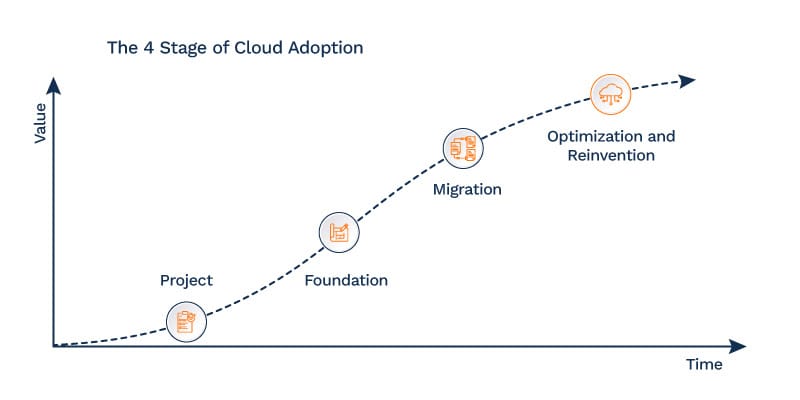
Phase One: Portfolio Discovery That Actually Surfaces Hidden Risk
This phase requires a detailed inventory of your applications, your data stores, and every dependency connecting them. Modern discovery tools like Cloudamize and Azure Migrate surface hidden integrations before they become mid-migration disasters.
Most teams skip this depth of discovery and pay for it later when a dependent system fails silently after cutover. Gartner's analysis shows that up to 40 percent of 2025 IT budgets are going toward maintaining technical debt. Quantifying that number in phase one makes the ROI case for modernization nearly self-evident to any finance stakeholder in the room.
Phase Two: Landing Zone Design That Standardizes Security Before Anything Moves
Network segmentation, identity controls, logging, monitoring, and policy enforcement get standardized here before a single workload migrates. Skipping this step means rebuilding security individually for every application you move, which multiplies both cost and compliance exposure in proportion to your portfolio size.
Phase Three: The Migration Factory Approach
Standardized pipelines, automated testing, reusable migration patterns, and central progress reporting mean you move dozens or hundreds of applications with consistent quality rather than treating each one as a bespoke project.
AWS research confirms that a mobilize-then-migrate pilot approach, starting with self-contained low-risk workloads, cuts average cutover defects by 63 percent. That is not a marginal improvement. That is the difference between a migration that builds organizational confidence and one that triggers a board-level conversation about why the program went over budget.
Phase Four: Continuous Optimization That Turns Migration into Ongoing Advantage
Migration creates a starting point, not a finish line. CloudZero's 2025 survey shows that proactive rightsizing alone cuts cloud spend by 18 percent on average. The organizations treating modernization as a one-time project are already falling behind the ones treating it as a continuous practice.
63% reduction in average cutover defects when enterprises use a mobilize-then-migrate pilot approach rather than migrating full application portfolios in a single wave.
How Smart Companies Are Using Data Governance to Outrun Their Competitors
Here is where most migrations fail silently: enterprises build distributed cloud environments without unified data governance.
You end up managing three different infrastructure stacks while pretending they operate as one. The gaps do not show up immediately. They show up six months later when a compliance audit reveals inconsistencies, or when your AI development team cannot get clean training data because the migration left fragmented records across environments.

The real-world impact of getting this right is striking. PayPal consolidated 300 petabytes of data fragmented across a dozen systems and achieved query performance improvements of 2.5x to 10x. Training data for their AI models became 16 times fresher.
Insights that previously took weeks now appear in minutes. That is not a technical result. That is a business transformation that flows directly from data governance being treated as a migration-critical workstream rather than a cleanup task after the cutover.
A Toronto fintech moved its payments engine to microservices and compressed four-hour nightly batch runs down to twenty minutes while achieving PCI-DSS compliance. A London retailer replaced an aging point-of-sale system and cut weekend release cycles from ten deployments to two.
The common thread across every successful case is that data quality and governance were built into the migration architecture, not retrofitted afterward.
The Security Gap That Is Quietly Exposing Your Organization to Regulatory Disaster
Your legacy systems almost certainly cannot support modern encryption standards, fine-grained access controls, or the audit trail requirements that GDPR, HIPAA, and PCI-DSS demand. When you migrate to the cloud without a security-first architecture, you are reconstructing the same vulnerability surface in a new environment and calling it progress. The regulators in the US, UK, Canada, and Australia are not going to accept that framing.
The zero-trust security model, where no user, device, or system is trusted by default regardless of network position, is the framework that leading enterprises are building into their cloud migration architecture from day one.

Multi-factor authentication, data encryption at rest and in transit, and continuous penetration testing are foundational requirements in this environment, not optional enhancements added when the budget allows.
Data integrity during migration deserves particular attention because this is where compliance exposure most commonly originates. Data mapping, minimization, and masking protocols need to be embedded in your migration workflow from the planning phase onward.
Policy-as-code tools like OPA and AWS Config allow compliance monitoring to be automated and continuous, producing exactly the evidence trail that regulators across every major market expect to see during an audit.
72% of enterprises now embed FinOps financial governance practices from day one of any cloud migration project, according to Flexera's 2025 State of the Cloud Report.
Competitors Have Already Unified Their Data.
The enterprises winning cloud migration in 2026 are the ones that built data governance into the migration architecture from the start, not the ones that treated it as a post-migration project. DataManagement.ai delivers real-time data validation, lineage tracking, and compliance automation across every phase of your legacy modernization. Your next migration phase is too important to start without it.

Your Legacy System Is Not a Stability Asset. It Is a Strategic Liability.
The window for treating cloud migration as a future-quarter priority is closing faster than most enterprise roadmaps acknowledge. The organizations that invested in modernization three years ago are now three years ahead in their ability to deploy AI capabilities, absorb new customer volume, and respond to market shifts without their infrastructure cracking under the pressure.
The four-phase framework, the right migration pattern for each workload, security architected in from the beginning, and a data governance layer that travels with the migration at every step are not optional enhancements. They are the foundational requirements for a modernization program that delivers real, measurable returns without destabilizing the operations your business depends on today.
The organizations winning the modernization race are not the boldest. They are the most disciplined. They assess before they act, plan before they migrate, and protect their data at every step of the journey. That discipline is what turns legacy constraints into the kind of intelligent, scalable data foundation your competitors are already building on. The only question left is how much longer you are willing to let them build it alone.
Thank you for reading
DataMigration.AI & Team